Why are rates falling now?
Financial markets and economists have revised their outlook for interest rates over the past week. Concerns about global instability — following the expansion of US trade tariffs under President Donald Trump — have increased the likelihood of slower economic growth.
In response, markets now expect deeper and more frequent rate cuts from the Bank of England over the next 12 months. Earlier in the week, analysts anticipated two cuts; by Wednesday, consensus had shifted to four.
Mortgage pricing often moves ahead of official announcements. As expectations for base rate cuts rise, swap rates — the mechanism lenders use to price fixed mortgages — have fallen. That has allowed some providers to reduce rates.
This article provides general information and is not personal financial advice.
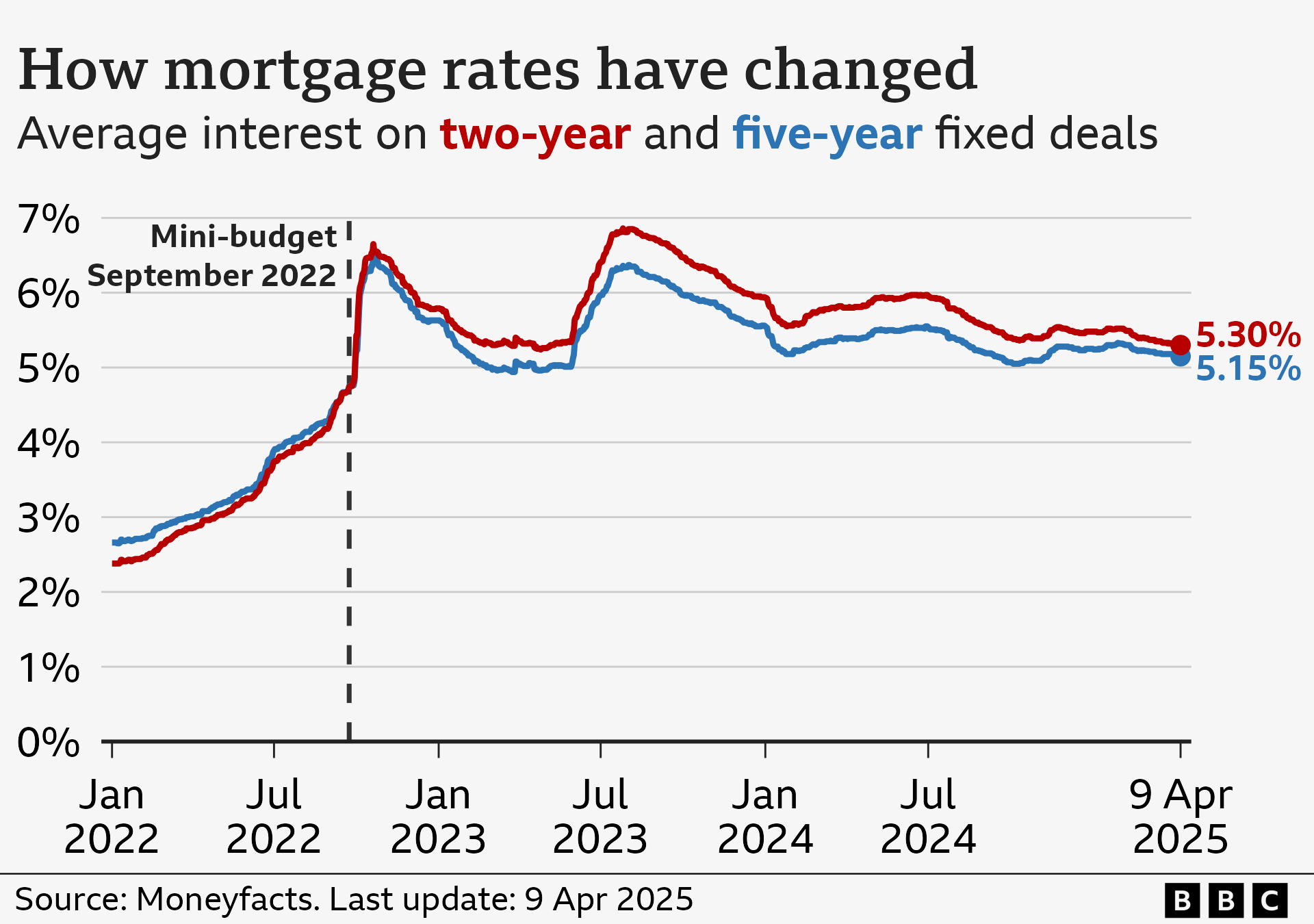
The current rate picture
According to financial data firm Moneyfacts:
- The average two-year fixed mortgage rate stands at 5.3%.
- The average five-year fixed rate is 5.15%.
While averages remain above 5%, select products have dipped below 4% for borrowers with larger deposits.
Coventry’s 3.89% deal, for example, requires:
- A 35% deposit (65% LTV)
- A £999 fee
- A fixed term until October 2027
Clydesdale Bank, Newcastle Building Society, TSB, Metro Bank, Bank of Ireland and Co-operative Bank have also announced rate reductions.
The UK’s largest lenders — including Nationwide Building Society, Halifax, HSBC, Santander, Lloyds and NatWest — have so far taken a more cautious “wait and see” approach. Brokers note that when these major players cut rates, the rest of the market often follows.
The refinancing challenge ahead
Despite recent reductions, many borrowers coming off older fixed deals are still facing higher costs.
Around 1.3 million homeowners will see their fixed-rate mortgages expire between April and December this year, according to the Financial Conduct Authority.
Many of these homeowners secured rates before mid-2021, when borrowing costs were significantly lower. Even with sub-4% deals returning in limited cases, refinancing could still mean a noticeable increase in monthly payments.
What borrowers should consider
The current market reflects expectations of future rate cuts — not confirmed policy decisions. If base rate reductions materialise more slowly than markets expect, mortgage pricing could stabilise or even reverse.
Shorter-term fixed deals may appeal to borrowers who expect rates to fall further. However, longer fixes provide payment certainty in an uncertain global environment.
Eligibility for the lowest headline rates typically requires:
- A substantial deposit
- Strong credit history
- Ability to meet lender affordability criteria
As always, individual suitability depends on personal financial circumstances.
What this means for you
If you are:
- Approaching the end of a fixed deal
- Considering remortgaging
- Entering the market as a first-time buyer
The reappearance of sub-4% deals may signal improving conditions — but competition and volatility remain factors.
Reviewing available products several months before your current deal expires can provide flexibility while protecting against unexpected rate movements.
You can explore current mortgage options based on your circumstances to understand how today’s rates might apply to you.
(Exploring options provides information only and does not constitute financial advice or a recommendation.)

